

Ending LLM bloat: How to integrate Jev and System One decision models into production architecture
Not every workflow needs generated text. A practical guide to turning Jev Choice, Score, and Noul decisions into a production layer with thresholds, auditability, and human review.
· TankDev Mühendislik
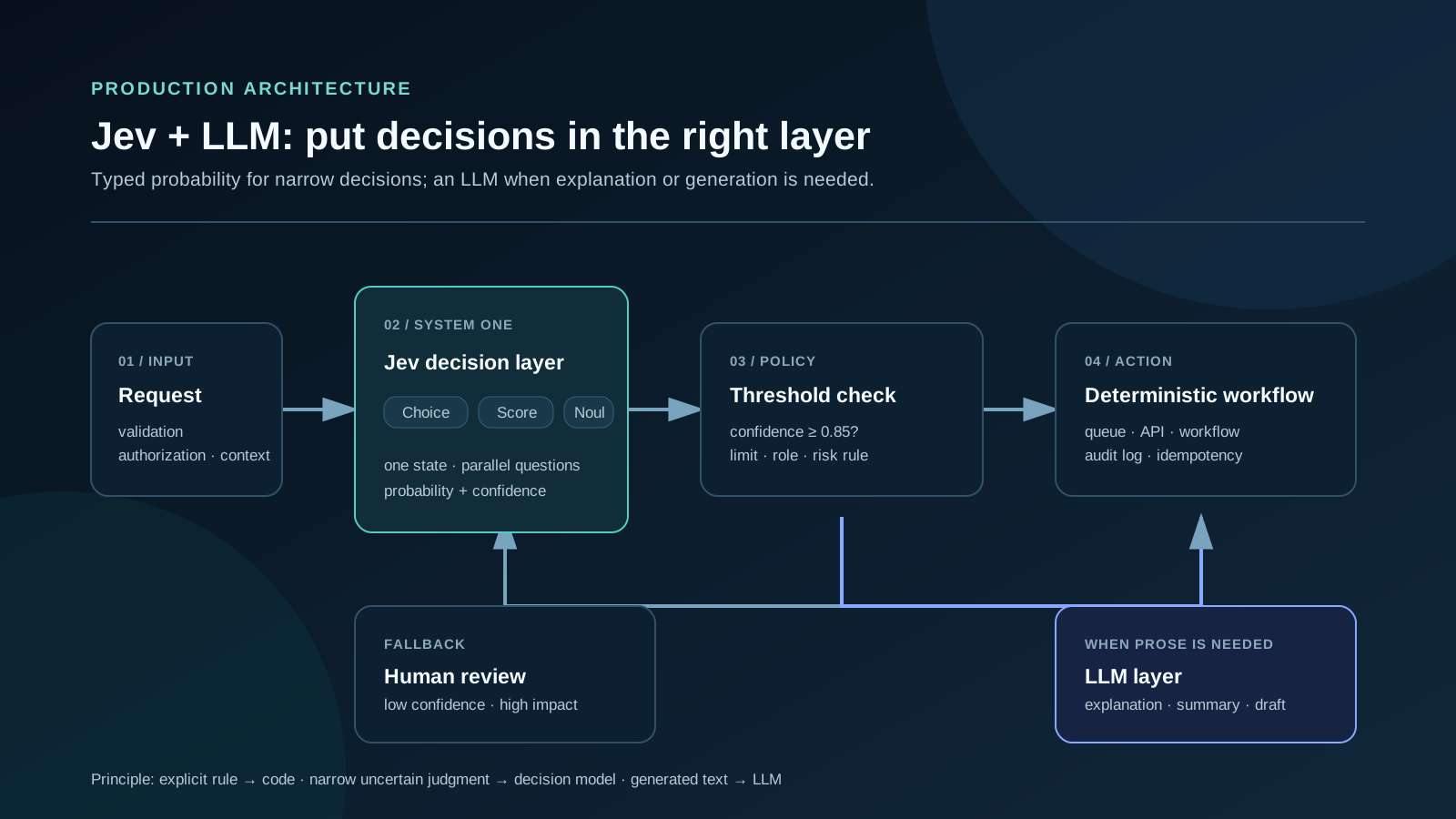
A meaningful share of AI automation cost comes from asking a large language model to make decisions that do not require generated text. Routing a ticket to billing, sales, or support; selecting a tool; or screening a request for risk does not inherently require a paragraph. Software needs a value it can execute, not prose for a person to read.
Jev is TypeSafe's System One decision model: an application sends state and typed questions, and receives a choice, score, or probability instead of generated text. The official documentation defines confidence for Choice and Score and a 0–1 probability for Noul. This does not make LLMs obsolete. It gives decisions and expression separate places in an architecture.
The problem: structured output is not automatically a structured decision
JSON Schema, function calling, and Pydantic can make an LLM response parseable. The model still interprets instructions, generates tokens autoregressively, and makes the application wait for that generation. A valid route: billing field does not establish that the route is correct, that uncertainty is handled, or that the call is economical for the workload.
System 1 and System 2: a useful architecture metaphor
Kahneman's System 1 / System 2 distinction is useful here as a technical metaphor. A System 1 layer makes a fast, narrow judgment: which queue, whether risk exists, which tool to select. A System 2 layer reasons across context, explains alternatives, and writes text. A conventional LLM often serves the latter role; decision models such as Jev fit narrow, measurable questions in the former. This is a division of work, not a hierarchy of intelligence.
User request
     │
     ▼
[Validation + authorization] ── invalid ──► reject / explain
     │
     ▼
[Jev: route, risk, human_needed]  ← one state, parallel questions
     │
     ├─ confidence ≥ threshold ─► deterministic workflow / tool
     ├─ confidence < threshold ─► human-review queue
     └─ prose required ─────────► LLM (draft, summary, explanation)
                                      │
                                      ▼
                              audit log + metrics
Three decision primitives: Choice, Score, and Noul
Jev constrains the shape of a decision before the request is sent. Instead of leaving the answer open-ended, the application states which kind of value it will consume. Independent judgments can be collected as one decision package because multiple questions on the same state are evaluated in parallel.
| Primitive | Question | Production example | Value consumed by code |
|---|---|---|---|
| Choice | Which option? | Which team owns this ticket? | billing | support | sales + distribution + confidence |
| Score | What level on a defined rubric? | How urgent is the incident? | probability-weighted score + confidence |
| Noul | Is this statement true? | Does this require human review? | P(true) ∈ [0, 1] |
{
  "state": {"subject": "My card was charged twice", "channel": "web", "account_tier": "enterprise"},
  "questions": {
    "route": {"type": "choice", "instructions": "Route to the accountable team.", "criteria": {"billing": "payment, invoice, or collection", "support": "product issue", "sales": "purchase or quote"}},
    "urgency": {"type": "score", "instructions": "Assess operational urgency.", "criteria": ["low", "normal", "high", "critical"]},
    "human_needed": {"type": "noul", "instructions": "Is human review needed because of financial harm or account security?"}
  }
}
Here, route is not a label for a dashboard: it selects a queue, SLA, and access boundary. urgency can drive prioritization. human_needed can stop an automated reply. Keep questions atomic. ‘Route this safely, urgently, and correctly’ combines unrelated judgments and is difficult to evaluate.
Cost and latency: compare the right unit
A universal benchmark would be misleading because context length, caching, output length, region, and concurrency change the result. TypeSafe advertises Jev at $42 per billion input tokens, or about $0.042 per million input tokens. An LLM decision cost includes more than input pricing: system instructions, generated structured output, possible repair calls, and waiting time. Measure p50/p95 latency, tokens per call, fallback rate, and the cost of incorrect decisions with your own traffic.
| Measure | Jev / System One decision layer | Structured-output LLM |
|---|---|---|
| Output | Typed choice, score, or probability | Generated JSON matching a schema |
| Execution | Narrow parallel questions over one state | Autoregressive generation with output tokens |
| Cost model | Input tokens plus platform cost | Input + output + possible retries |
| Latency | Measure on the target short decision | Varies with model, load, and output length |
| Best fit | Routing, gates, classification, risk signals | Explanation, summary, advice, and generation |
The TankDev decision benchmark: a measurement contract
A provider demo cannot prove that an architecture is fast or inexpensive for a production domain. Decision quality depends on the data domain, the definition of options, and the cost of a wrong result. TankDev's recommended benchmark runs one closed evaluation set through three paths: deterministic rules, Jev/System One, and a structured-output LLM. The aim is not the largest headline percentage; it is to show which decisions can safely be automated in which layer.
Labeled evaluation set (for example, 500 anonymized requests)
                  │
                  ├──► Deterministic rule ─────────► result + duration + cost
                  ├──► Jev / System One ───────────► result + distribution + confidence
                  └──► Structured-output LLM ──────► result + output tokens

For every result: correct label • p50/p95 • call cost • fallback • human override
Segment separately: channel • language • account type • novel/rare category| Measure | How to calculate it | Why it matters |
|---|---|---|
| Selective accuracy | Correct rate among decisions actually automated | Shows automation quality above the confidence threshold |
| Coverage | Share of all records that received an automatic action | Prevents looking good only on easy examples |
| Risk-weighted error | Weight each wrong result by business impact | Separates a misroute from a money or access error |
| p50 / p95 latency | Time from client request to decision | Exposes queues and tail values that an average hides |
| Fallback and override | Rate of human review or later correction | Shows threshold and question-design maturity |
This article makes no numerical benchmark claim; it provides a results template. Before publishing actual results, document the data source, sample size, labeling method, model/question version, date range, and exclusion criteria. Without that, a comparison is a marketing chart rather than engineering evidence.
| Method | Selective accuracy | Coverage | p95 | Call cost | Note |
|---|---|---|---|---|---|
| Rule engine | to measure | to measure | to measure | to measure | Reference for explicitly governed examples |
| Jev / System One | to measure | to measure | to measure | to measure | Report with confidence threshold and calibration |
| Structured-output LLM | to measure | to measure | to measure | to measure | Separate schema validity from decision correctness |
Hybrid production architecture: decision model, policy, and LLM
Do not attach a decision model directly to an external side effect. Put a policy layer between the decision and the action. The policy engine applies thresholds, user roles, transaction limits, operating hours, retry count, and risk classes. The model may say that a vendor payment is high risk; explicit application policy decides whether money can move.
const decision = await jev.decide(ticket);
const autoRoute = decision.route.confidence >= 0.85;
const needsReview = decision.human_needed.noul >= 0.20;

if (!autoRoute || needsReview) {
  await reviewQueue.enqueue({ ticketId, decision, policyVersion: "2026-09-27" });
  return { status: "pending_review" };
}

await workflow.dispatch({ queue: decision.route.choice, ticketId });
// Call an LLM only when a human-readable draft or explanation is required.
Confidence is not authority: calibration and thresholds
A confidence of 0.85 only approaches ‘85% correct’ when the model is calibrated on your domain. Begin in shadow mode: record recommendations, compare them with an existing rule or human outcome, and inspect error by segment. Language, customer tier, channel, product family, and newly introduced categories need separate measurement.
- Log a safe state reference, model version, question/policy version, result, distribution, threshold, and final action for every decision.
- Choose thresholds from false-positive and false-negative cost, not headline accuracy.
- Do not turn low confidence into an automatic rejection; design review, an alternate path, or a request for richer context.
- Compare old and new versions under controlled traffic whenever the model or question text changes.
What Jev does not do
Jev does not write text. It is therefore not the right tool for explanations, long summaries, code, or multi-step research. A fixed output space prevents an invented schema value, but it does not prevent a high-confidence selection of the wrong defined option. ‘Zero hallucinations’ must not be interpreted as correct business decisions. If a deterministic rule already exists—such as amount > 100000—use ordinary code rather than a model call.
Production release checklist
- Write the business goal, allowed actions, and reversibility of each decision.
- Describe every Choice option and Score level with observable criteria.
- Prepare an evaluation set from labeled or human-decided examples; do not reuse training examples.
- Specify a fallback for low confidence, timeout, and service failure.
- Monitor queue delay, model latency, confidence distribution, override rate, error rate, and call cost.
- Apply dual approval, limits, idempotency, and audit logs to high-impact actions.
TankDev treats AI automation as a system of APIs, data, permissions, business rules, queues, and observability—not merely a model call. Read our guide to AI automation with LLMs, APIs, and workflows and the TAARM reliability model. Share the decision points in your automation, and we can design which layer should be code, a decision model, or an LLM.
Frequently asked questions
01Is Jev an LLM?
No. TypeSafe defines Jev as a System One decision model that does not generate text. It accepts state and typed questions, then returns Choice, Score, or Noul results. It does not replace an LLM for conversation, long explanation, or content generation.
02Why use Jev when Structured Outputs exist?
Structured Outputs constrain shape; they do not by themselves solve an LLM's generation cost, latency, or decision uncertainty. Jev provides typed probability and confidence signals for narrow decisions that code consumes. The right approach depends on measured performance and the cost of an error.
03Does Jev avoid hallucinations?
It cannot create a class outside the defined schema. It can still select the wrong existing option. Confidence, evaluation data, thresholds, fallback behavior, and human approval for high-impact actions remain necessary.
04Why does Jev not provide a written rationale?
It is designed to produce a fast machine-consumable decision, not an explanation. When a user needs a rationale, build a separate explanation flow using the decision record and relevant business data with an LLM or human review.
05Where does Jev fit in an agent architecture?
Place it at early decision points: tool selection, risk gating, routing, spam or suitability filters, and triggers for human review. A Jev result must not be authority on its own; combine it with policy, permissions, limits, and an audit log.
06Should the confidence threshold always be 0.85?
No. There is no universal threshold. Set it using calibration on your labeled examples and the cost of an incorrect outcome. Low-impact routing can tolerate a different threshold from a payment or permission change that requires human approval.