

Why Is Your Website Not Selling? A 2026 Guide to Next-Generation AI- and ERP-Integrated Web Apps for SMEs and Enterprises
From lost sales to system design: Next.js, Core Web Vitals, RAG product search, ERP/WMS/CRM integration, headless CMS, and SEO/GEO, with engineering detail and business explanations.
· TankDev Engineering
On Monday morning, the sales team has three different problems. A customer discovers that an item sold as available is missing from the warehouse. Another is still waiting for a quotation requested on Friday. A third bought from a competitor after failing to find a product through search. The website is online, the homepage is new, and the ads are running. The business workflow is failing.
For years, company websites were designed as brochures. A brochure still has a purpose: explaining who you are, what you do, and why someone should trust you. The trouble starts at the next step. A customer who needs account pricing, the right product, a delivery date, or an application status is not looking for another paragraph. They want to finish a task.
In 2026, the meaningful difference between a website and a web application is not animation or framework branding. It is how much of that task can be completed reliably. We will follow an illustrative safety-equipment supplier selling to individuals and offering contract pricing and quotations to business accounts. ERP/WMS owns inventory, while CRM tracks sales follow-up. Each engineering section is followed by its practical business meaning.
At TankDev, we design web-based systems, applied AI, and system integration together. That does not mean assigning the same technology list to every project. We first establish which work is being lost, which data is authoritative, and where automation must stop. The scenario, numbers, and code below explain that approach; they are not reported customer performance results.
Start with diagnosis: traffic exists, but where does the sale disappear?
“My website is not selling” is not a single defect. Low-intent traffic, an unclear offer, unreliable product information, slow interactions, failed payment, and lost sales enquiries can look identical in a summary report. Before redesigning, instrument product view → search → cart/quotation → durable acceptance → payment/CRM acceptance → realized sale. A B2B quotation needs a different conversion window from a consumer card payment.
Illustrative monthly funnel, not a measured case study:
10,000 eligible sessions -> 500 cart/quote starts -> 200 durable submissions
120 completed sales, observed after the agreed attribution window

Submission rate = 200 / 10,000 = 2%
Realized sales rate = 120 / 10,000 = 1.2%

If a controlled change raises submissions to 250 AND the 60% close rate holds:
250 * 0.60 = 150 sales => 30 additional sales
Incremental contribution = 30 * contribution_margin_per_sale
This is a scenario, not a forecast or a framework performance claim.
A browser click, a durably accepted order, and captured funds are separate events. Use event_id and order_id/lead_id to deduplicate measurement rather than counting browser and server reports as two purchases. Consent choices, blockers, and cross-device journeys can leave gaps. Financial outcomes and operational records cannot simply be equated with an analytics conversion count.
For the business: will a new homepage fix the problem, or does the team need to answer existing enquiries promptly? Establish that first. More advertising may otherwise send more people into the same broken workflow.
1. Why customers leave: performance, uncertainty, and unfinished tasks
Engineering: read Core Web Vitals alongside business metrics
A late product image, an unresponsive filter, and a shifting checkout button are different failures. LCP tracks loading, INP interaction responsiveness, and CLS visual stability. The Web Vitals guidance defines good thresholds as LCP ≤ 2.5 seconds, INP ≤ 200 ms, and CLS ≤ 0.1, assessed at the 75th percentile of real users, with mobile and desktop considered separately.
A score of 100 in one Lighthouse run does not prove that customers share the same experience. Lab tests expose regressions; real-user monitoring reveals device, network, and page-type distributions. Track product details, search, account carts, and checkout separately. Backend services also need p95/p99 latency, error rates, and dependency timing. Good LCP can coexist with inventory requests that frequently time out.
We do not claim that a 100 ms improvement caused a particular sales increase without evidence. Acquisition source, promotions, stock, pricing, and device mix change conversion. Prefer a controlled experiment; otherwise document comparable segments, periods, and changes. Performance also matters beyond the first page: repeated waits during search, cart updates, and quotation can affect task completion.
Why Next.js? SSR, static rendering, and cache boundaries
One reason TankDev may choose Next.js for a custom web application is that it does not require server-rendering every request. Public descriptions and guides can be prerendered or cached deliberately. Server Components keep data preparation on the server and help limit browser JavaScript; filters and carts use client-side interaction where needed. The Next.js component model explains that separation. Actual performance still depends on data access and asset budgets.
Putting private account prices in a shared CDN cache is a data leak, not a performance optimization. Define public cache keys around locale, currency, and content version. Apply explicit private/no-store policies to tenant-specific quotations and prices. A stock badge may use a short-lived read model; order-time reservation is validated against its authority. TTL and periodic reconciliation cover missed invalidation events.
Illustrative route/data policy, independent of framework defaults:
/products/{slug}           Public editorial shell; versioned cache
/api/catalog/search       Public fields only; query/locale-aware cache
/api/account/prices       Authenticated, tenant-scoped; private, no-store
/api/cart                 Authenticated or scoped session; private, no-store
/api/orders               POST; server-side price/stock checks + idempotency
/api/orders/{id}          Object authorization on every read

Public HTML / JSON-LD must never contain another account's negotiated price.
Availability shown during browsing is not an inventory reservation.
WordPress is not inherently slow, and Next.js is not automatically fast. WordPress can produce server-rendered HTML and perform well with appropriate hosting, restrained plugins, and caching. Its optimization documentation covers those operational factors. For ERP connections, specialized authorization, and complex workflows, we prefer custom components we can control more directly than a plugin chain. That control brings development and maintenance responsibilities.
For the business: speed means letting customers finish
Customers do not see the framework name. They see whether the product opens, the price makes sense, and submitting has an understandable outcome. Base the investment on the blocked task, incomplete enquiries, and measurable benefit. A complex portal may be uneconomical for a small brochure site; changing a theme may be insufficient for an account-ordering and ERP workflow.
2. Intelligent search and personalization: connect intent to products
Engineering: combine exact matching, filters, and semantic retrieval
One customer asks for waterproof boots for outdoor winter work in Ankara. Another knows only a product code. Applying identical vector search to both is not good search design. Codes, barcodes, and exact names need deterministic matching; category, size, certification, and price become structured filters. Natural-language use cases provide an additional semantic-retrieval signal.
A search pipeline can normalize the query, retrieve exact/lexical and vector candidates, enforce authorization and product constraints, merge/rerank, and then hydrate current price and stock. RAG connects selected, authorized evidence to a model for explanation. The model cannot invent product IDs, certifications, or delivery dates. No verified match is a better outcome than a confident but unsupported recommendation.
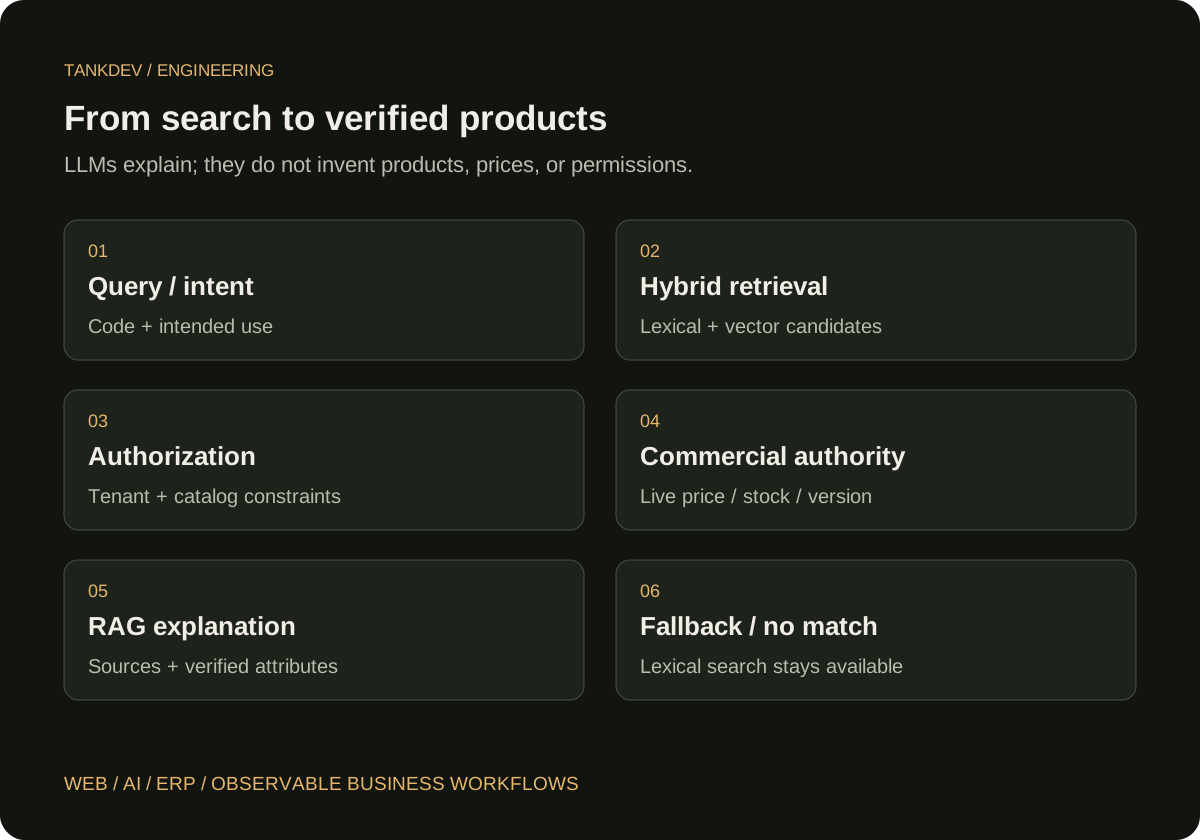
Do not treat prices or stock embedded in a vector index as current truth. The index retrieves meaning; product/ERP services provide commercial facts. Store source version, language, and technical attributes with embedding records. Separate embedding versions when models change so indexes can be rebuilt. For some small or medium catalogs, pgvector in an existing PostgreSQL deployment is sufficient. The pgvector documentation describes exact/approximate search and filtering; validate recall and latency on the actual catalog.
{
  "query": "waterproof winter work boots, size 42",
  "constraints": {
    "category": "work-boots",
    "size": "42",
    "waterproof_claim": "verified"
  },
  "candidate_ids": ["SKU-42-A", "SKU-42-B"],
  "evidence": [
    {"product_id": "SKU-42-A", "source_version": "spec-v18", "field": "waterproof"}
  ],
  "commercial_data_source": "authoritative-product-service",
  "policy": "explain_only_returned_candidates; no_purchase_authority"
}
Authorization is more than removing names from the final answer. Restricted catalogs, negotiated price lists, and technical documents must stay within authorized retrieval scope, with object checks at the final boundary too. A user query cannot choose its tenant. Instructions embedded in product content cannot grant tool permissions. Personalization should use explicit preferences and permitted account context rather than sending every customer record to a model.
Quality requires a representative labeled query set covering codes, misspellings, ambiguity, no-match queries, and safety-relevant attributes. Recall@k measures candidate retrieval; constraint accuracy measures suitability; unsupported-claim rate tracks statements without evidence. Monitor p95 response time, cost per search, zero-result rate, and search-to-cart/quotation progression together. Lexical search should remain available if the model fails.
For the business: do not force every visitor into a chat
A purchasing officer with product codes needs quick ordering; an uncertain customer needs guidance. Giving them different paths is useful sales support. AI creates value by reducing product-finding time and repeated questions, not merely by adding a chat box. Claiming an unverified safety feature creates risk rather than useful sales assistance.
3. ERP, inventory, WMS, and CRM: the correctness contract behind a sale
Engineering: identify the owner of each fact and decision
A web application is more than its frontend: it includes APIs, business rules, persistence, and integration boundaries. Drawing a stock number is easy. Deciding which of two simultaneous customers receives the last item is harder. ERP, WMS, and application databases may use “stock” for different quantities: on-hand, available, reserved, in transit, and safety stock.
| Fact / decision | Authority | Web application responsibility |
|---|---|---|
| Editorial descriptions and guides | CMS | Publish approved locale/version |
| SKU, variants, technical fields | ERP or PIM contract | Maintain read models and search indexes |
| Contract prices, tax, discounts | Commercial pricing service / ERP | Read with authorization; validate at transaction time |
| Available stock and reservation | Designated inventory authority | Display; request reservation during ordering |
| Web-order acceptance | Order service | Idempotent persistence and explicit states |
| ERP record / fulfillment | ERP / WMS | Map external identifiers and status |
| Enquiry, assignment, follow-up | Lead service + CRM contract | Durable acceptance, delivery, SLA tracking |
A browsing stock badge can tolerate some delay; order confirmation cannot use the same loose contract. Use atomic reservation from the designated inventory authority where available. Without it, accept a request pending confirmation, or manage inventory allocated to the web channel. Locking a counter only in the web database cannot prevent cross-channel overselling if ERP or a physical store can sell the same item independently.
-- PostgreSQL illustration: valid ONLY if this inventory ledger is the
-- reservation authority for the relevant channel/allocation.
BEGIN;
INSERT INTO orders(id, tenant_id, idempotency_key, request_hash, state)
VALUES (:order_id, :tenant, :key, :hash, 'PENDING');
-- UNIQUE(tenant_id, idempotency_key). On conflict: ROLLBACK,
-- load the original order, compare its request hash, return it or 409.
-- Resolve duplicate admission BEFORE attempting another reservation.

UPDATE inventory_allocations
SET reserved = reserved + :qty, version = version + 1
WHERE sku = :sku AND channel = 'web'
  AND :qty > 0 AND on_hand - reserved >= :qty
RETURNING sku, version;
-- Require exactly one updated row; otherwise ROLLBACK / unavailable.
UPDATE orders SET state='RESERVED' WHERE id=:order_id;

INSERT INTO outbox(event_id, aggregate_id, event_type, payload)
VALUES (:event_id, :order_id, 'order.accepted.v1', :payload);
COMMIT;
-- External ERP/payment calls happen after this transaction.
Never accept a browser-supplied total as authoritative. Re-evaluate account, currency, quantity, tax, promotions, and price version on the server; show a changed total before confirmation. Payment authorization/capture and inventory reservation are not one distributed transaction. Define release on failed payment, review or cancellation/refund on ERP rejection, and other compensations explicitly. If the payment response is lost, use the provider’s idempotency and status contract rather than blindly charging again.
What do outbox, idempotency, and reconciliation actually solve?
The order commits, then the ERP call times out. Calling it failed is insufficient: ERP may have created the order while its response was lost. Store the relationship between order_id and external_order_id, idempotency key, request hash, and attempt history. Committing an outbox event with the order closes the gap between persistence and later transmission. The transactional outbox explanation describes that dual-write boundary.
An outbox does not make ERP continuously available. It preserves transmission intent and enables retries. The relay can deliver duplicates, requiring receiver deduplication or a queryable external operation identifier. Retries need backoff, jitter, attempt limits, and business deadlines. Repeating a permanent error such as an unsupported product code will not fix it; create an inspection record, alert, and operational owner.
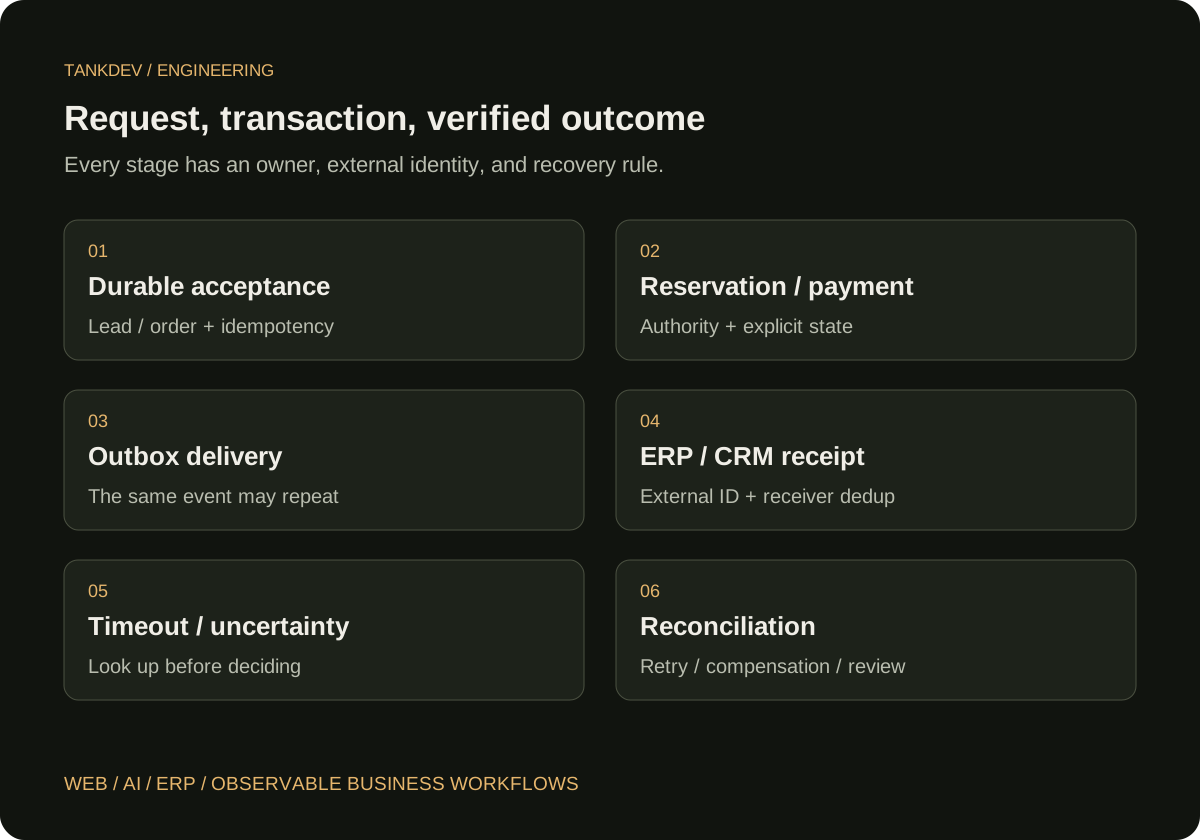
Reconciliation is the safety net around event delivery. Query aged ERP_PENDING orders by external reference and compare delivery records with ERP. Recover missed webhook updates and flag inconsistent records. “Awaiting ERP confirmation” is more accurate than labeling an uncertain outcome complete. Define degraded behavior in advance: keep the public catalog available while suspending firm availability commitments if its authority is unavailable.
CRM: submitting a form is not the same as following up
For quotations, validate and rate-limit the submission, durably create a lead, and return lead_id. CRM delivery and email notification can consume separate outbox events; failed email must not erase the enquiry. Track assigned team, next_action_at, CRM acceptance, and response time. Idempotency connects a resubmitted mobile request to the original lead. Similar email addresses alone are not enough to merge distinct enquiries automatically.
Our API and system integration guide expands this protocol. If long-running AI jobs are involved, asynchronous LLM worker architecture covers the corresponding acceptance, ownership, and retry boundaries on the inference side.
For the business: customer status must match operational reality
Order received, payment captured, and ready to ship are different statements. Customers need the actual stage, while staff need to know which records require action. Measure integration value through duplicate-entry time, stock conflicts, forgotten quotations, repeated transactions, and status enquiries. Instead of promising no outages, design how work survives them and what staff do next.
4. Headless CMS: one publishing workflow, multiple channels, clear ownership
Engineering: separate CMS, PIM, and ERP responsibilities
A headless CMS separates content management from a particular page theme. Editors manage guides, service descriptions, and campaigns; web and mobile clients consume a versioned API. Instead of embedding product data inside a page, content models hold relationships, such as product_id references from a guide rather than manually copied product codes.
Editing prices, inventory, and account discounts in the CMS breaks ownership again. CMS owns editorial content, an optional PIM owns rich product information, and ERP/commercial services own prices and transactions. One center does not mean one database containing everything. It means a coherent interface that composes authoritative sources without making staff update the same fact manually in three places.
{
  "content_id": "guide-winter-workwear",
  "schema_version": 3,
  "locale": "tr",
  "status": "published",
  "revision": 18,
  "product_refs": ["SKU-42-A"],
  "seo": {"canonical_path": "/tr/rehber/kislik-is-ekipmani"},
  "commercial_fields": "resolved_by_product_and_pricing_services"
}
Define drafts, review, approval, scheduling, and rollback. Authenticate previews and keep drafts out of public caches and sitemaps. Validate webhook signatures and event IDs before invalidating relevant caches or updating search indexes. Preserve contracts for older mobile clients when schemas evolve. In multilingual publishing, connect translated content, canonical URLs, and hreflang relationships to the release checks.
Headless CMS and micro-frontends are separate decisions. Micro-frontends can help when independent teams need independent UI delivery. They also introduce runtime dependencies and work around shared design, sessions, accessibility, version compatibility, and observability. For one product team and a limited set of screens, a modular Next.js application may meet the need with less operational overhead. Micro-frontends are not a starting requirement here.
For the business: stop correcting the same description in three places
Editors should not need a development ticket for every text change. Publishing an incorrect price everywhere at once is not success either. Give each team control over the right fields: editorial content, commercial policy, and warehouse movement. Recording the publisher and revision removes guesswork from “who changed this?”
5. An AI-readable web application: SEO, GEO, and entity consistency
Engineering: separate discoverable content from private transactions
An AI assistant inside your site and your site appearing in external AI search are different projects. One is a product feature connected to your catalog and services. The other concerns discovery, interpretation, and selection of public information as a source. A good chatbot does not establish Google indexability, and adding schema does not fix product search.
Public product, category, and service pages need stable URLs; important information should not require login or a chat interaction. Align HTML, titles, headings, descriptions, internal links, and real HTTP statuses. Modern frameworks can still serve empty 200 pages for removed products, expose endless indexable filter combinations, or canonicalize translations incorrectly. Technical SEO needs an explicit publishing policy.
An entity is the distinguishable identity of a company or product. Company names, domains, contacts, and verifiable profiles should remain consistent across Turkish and English pages. Use stable Organization identifiers and product identities, with genuine GTIN and brand relationships where applicable. Do not invent certifications, reviews, or branches. Keeping website location/contact facts consistent with real business profiles is part of the same data-quality work.
{
  "@context": "https://schema.org",
  "@graph": [
    {
      "@type": "Organization",
      "@id": "https://supplier.example/#organization",
      "name": "Example Safety Supplier",
      "url": "https://supplier.example/"
    },
    {
      "@type": "Product",
      "@id": "https://supplier.example/products/boot-a#product",
      "name": "Work Boot A",
      "sku": "SKU-42-A",
      "description": "Public description matching the visible page"
    }
  ]
}
This shortened JSON-LD demonstrates identity relationships; it is not a complete merchant-listing implementation. A genuinely purchasable page needs Offer, price, currency, availability, and other applicable fields matching visible content. Follow Google’s merchant-listing documentation. Never expose negotiated prices in public structured data or fabricate a public offer when none exists.
For GEO, provide concrete facts a source-based answer can use: who the service is for, which problem it solves, scope, prerequisites, and supporting evidence. Build that through distinct service pages, comparisons, engineering explanations, and verifiable case records rather than repeated keywords. Answer the decision questions specific to each page instead of copying the same long FAQ everywhere.
Google’s AI features guidance does not require a special AI schema or additional AI files for AI Overviews and AI Mode; foundational SEO and indexing eligibility remain relevant. That describes Google, not every AI system. Technical eligibility is not a visibility guarantee. The FAQ in this article serves readers; it does not promise a special search appearance.
Record branded/unbranded queries, country, language, device, and date. Keep Google impressions/clicks, AI brand mentions, cited source URLs, and referred visits separate. Zero referral traffic does not establish zero mentions, while one successful prompt is not durable visibility. Use repeated observations across a fixed query set, page versions, and business outcomes. Our ChatGPT visibility guide and technical SEO/GEO article develop those distinctions.
For the business: describe the company accurately to search systems
Rather than saying “recommend us,” explain what you do, for whom, and under which conditions. Purchasing teams and search systems both need answers to those basic questions. TankDev’s GEO service connects that information with content, entity modeling, technical access, and measurement. Our own-site SEO/GEO case record shows evidence for specific technical checks; we do not equate those checks with sales growth or guaranteed AI recommendations.
6. Security, accessibility, and operations: the less visible delivery scope
Hiding an account-page button is not authorization. APIs enforce tenant, role, and record ownership on every operation. Design administrative sessions, distinct service identities, least privilege, secret rotation, and auditing. Validate uploaded files for size, type, and unsafe content rather than placing them indiscriminately in public directories. Keep passwords, tokens, card data, and raw customer documents out of logs. Use supported payment-provider flows without unnecessarily handling sensitive card data.
Accessibility is part of task completion: keyboard product selection, labeled fields, useful error summaries, readable contrast, visible focus, and screen-reader status announcements. Incorrect mobile input types or disappearing fields can stop a sale. A design that looks good only on a wide desktop is not enough for acceptance.
HTTP uptime alone is not enough. Monitor checkout errors, oldest pending CRM enquiry, ERP delivery age, AI fallback rate, and pricing/inventory read-model lag. Correlation IDs connect customer operations to dependencies. Creating a backup and restoring it are separate tests. Agree on RPO, the acceptable data-loss window, and RTO, the recovery target, then measure them during recovery exercises.
For the business: knowing what happens under specific failure conditions is more valuable than a promise of a flawless digital employee. Can enquiries be accepted while ERP is offline? Who receives the alert? How many orders would yesterday’s backup omit? TankDev’s engineering scope includes those answers, acceptance scenarios, and operating documentation.
7. Investment and migration: when does a web application make sense?
Engineering and commercial evaluation: from build price to ownership cost
Initial development is only part of total cost of ownership. Include hosting, databases, backups, bandwidth, inference, CMS licensing, integration maintenance, monitoring, and staff time. Evaluate contribution margin rather than revenue, and time that is actually freed for useful work. An hour saved does not automatically become cash savings. Avoid counting the same improvement both as extra sales and labor savings.
Illustrative monthly calculation, not a quotation:
Automatable manual work: 400 operations * 6 min = 40 hours
Residual exception work after automation: 10 hours
Potential released capacity: 30 hours

Net monthly value = incremental contribution margin
                  + monetizable released capacity
                  + avoided error cost
                  - incremental operating cost

Simple payback = initial investment / positive net monthly value
Test low/base/high assumptions; include rollout and maintenance costs.
If net value <= 0, the proposed scope needs to change.
A single fixed price for every ERP integration is misleading. Supported APIs, sandbox access, data cleanup, mappings, authorization, and recovery requirements change the effort. Not every catalog needs AI either; exact search and filters can solve many problems for less. Establish the need for independent deployment and capacity before requiring Kafka clusters, Kubernetes, or micro-frontends in the first release.
| Phase | Deliverable | Acceptance evidence |
|---|---|---|
| Diagnosis | Funnel, data ownership, API/environment inventory | Blocked step and authority identified |
| First workflow | Durable quotation or bounded ordering | Duplicate/timeout/authorization scenarios |
| Integration | ERP/CRM mappings and reconciliation | Counts, external IDs, and states reconcile |
| Search and content | Evaluated retrieval and CMS workflow | Labeled queries, rollback, cache tests |
| Progressive rollout | Bounded traffic/account cohort | Performance and business guardrails |
| Operational handover | Alerts, runbooks, recovery, ownership | Team can execute failure procedures |
Do not launch a redesign without inventorying existing URLs, valuable landing pages, and internal links. Map changed URLs to semantically equivalent destinations with single-step redirects rather than redirecting everything home. Check sitemaps, robots, canonicals, hreflang, and analytics in staging and production. Order migration requires count/total/identity reconciliation and a cutover plan. Rollback includes preserving newly written data, not simply restarting the old frontend.
Where does TankDev fit?
At TankDev, we develop this scope across interfaces, services, data models, role/object authorization, integration contracts, and release/operating practices. We integrate existing models when they suffice and consider custom models when the task and data require them. The objective is a system whose operating conditions and recovery behavior are understood, beyond a working demonstration.
Make delivery concrete through source code and versioning, API/data contracts, access ownership, environment setup, monitoring, and acceptance records. Agree early on maintenance ownership, retesting after model or ERP changes, and incident response. Our PoC-to-production guide explores the relationship between architectural decisions and operating cost.
For the business: buy completed work, not just screens
Looking for a low-cost website can be reasonable when you only need a basic business presence. If you expect customer accounts, contract pricing, inventory, quotations, and ERP delivery, the scope changes. Compare completed work, correctness, staff time, and ownership cost rather than page counts. Before comparing cheap and expensive, establish whether the deliverables are actually the same.
A digital employee is a useful metaphor: the application accepts a request, validates it, transfers it, and reports status. That employee still needs permissions, limits, and an owner. To examine where your site loses sales or operational work, discuss the scope with TankDev. The starting point is identifying the customer’s unfinished task, before choosing a new theme.
Frequently Asked Questions
01My website gets visitors but no sales. What should I check first?
Separate traffic intent, offer clarity, and conversion steps. A click is not a sale: reconcile durable submissions, payment/CRM acceptance, and realized sales. A redesign may not fix an unidentified workflow defect.
02What is the difference between a website and a web application?
A website primarily publishes information. A web application handles sessions, authorization, inputs, business rules, and durable operations. Public content and a private customer portal can coexist in one project.
03Will replacing WordPress with Next.js increase sales?
Not by itself. WordPress can perform well. We may choose Next.js for more direct control over interfaces, caching, authorization, and integrations. Measure commercial impact through completed tasks and actual data.
04What are good Core Web Vitals values?
Target LCP at most 2.5 seconds, INP at most 200 ms, and CLS at most 0.1, evaluated at the 75th percentile of real users and separated by mobile/desktop. These thresholds are not a sales guarantee.
05Does intelligent product search require a custom LLM?
No. Start with catalog quality, exact matching, and filters. Add controlled RAG with existing embeddings/models where useful. A custom model needs justification from the task and data.
06Can AI invent a price or availability?
In an uncontrolled design, yes. Restrict recommendations to authorized candidates, hydrate commercial facts from authoritative services, and test unsupported claims. AI should not independently authorize orders, payments, or firm availability promises.
07Can a web application integrate with an ERP without an API?
Evaluate vendor-supported files or permitted integration channels. Without reliable identity, transfer, and retry contracts, do not promise firm real-time transactions. A suitable method may not exist.
08Does outbox completely prevent duplicate orders?
No. Outbox commits local state with transmission intent, but delivery can repeat. Business operations and receivers still need idempotency/deduplication, external identifiers, and reconciliation.
09Should a headless CMS manage prices and inventory?
Not in this design. CMS publishes editorial content; authoritative commercial systems own prices and stock. Web and mobile clients compose those sources through controlled APIs.
10Does GEO guarantee that ChatGPT recommends my company?
No. Technical access, consistent entity facts, and useful content reduce ambiguity without guaranteeing recommendations. Measure mentions, citations, referrals, and conversions separately.
11How much does an AI- and ERP-integrated web application cost?
There is no universal amount. API suitability, data quality, screens/roles, recovery, security, and operations determine scope. Evaluate development alongside infrastructure, inference, licensing, and maintenance.
12Does TankDev only build the interface?
No. Depending on scope, we design and develop interfaces, backend services, data models, authorization, ERP/CRM integration, AI workflows, technical SEO/GEO, and release/operating practices together. Agree on requirements and acceptance criteria at the start.