

Applied on TankDev / SEO + GEO
TankDev SEO and GEO Infrastructure: From Measurement to Evidence
On our own website, we connected technical SEO, consistent entity relationships, and AI-search visibility measurement in one engineering workflow. Five genuine screenshots document performance, crawling, structured data, and citation observations.
- Project
- TankDev’s own web infrastructure
- Field
- Technical SEO · GEO · entities · measurement
- Languages
- Turkish and English
- Evidence set
- 5 screenshots supplied by the site owner
- Published
- 28 October 2026
- Method
- Implementation + external-tool verification
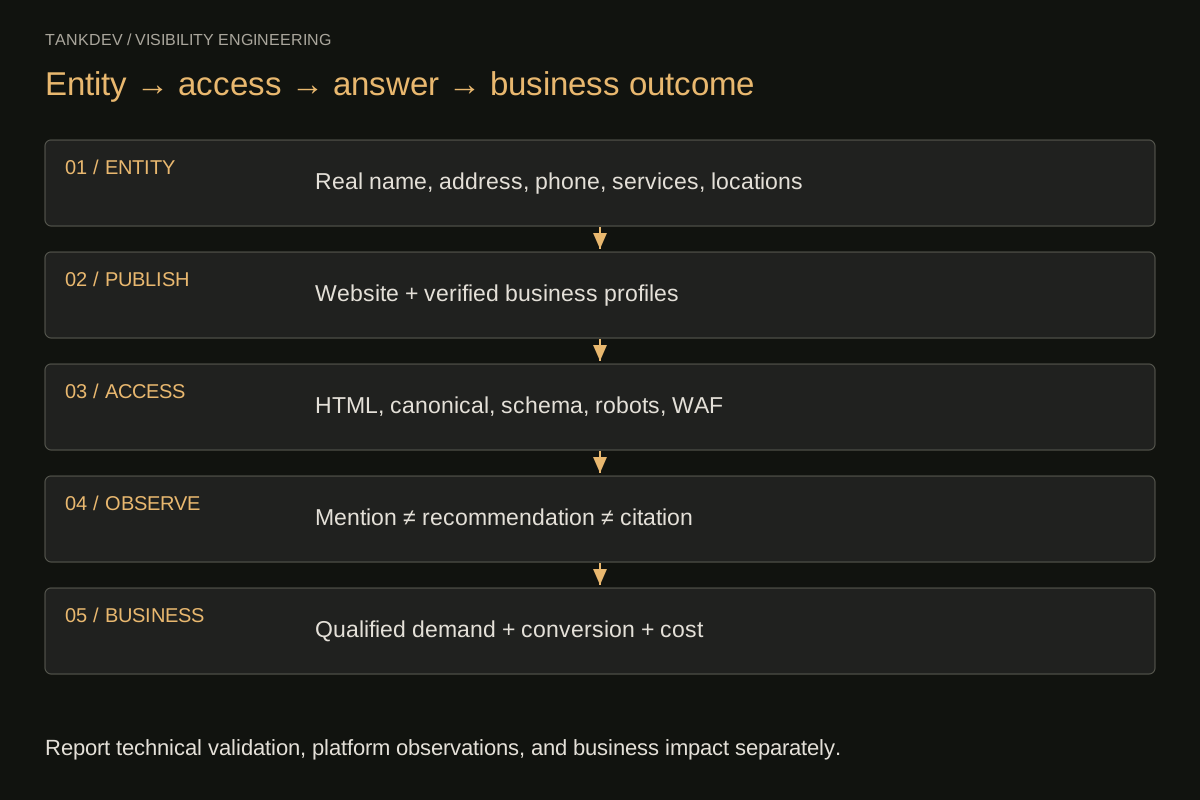
Each value belongs to its own report scope and observation time. Different tests are not combined into one invented “GEO success score.”
The problem: being searchable is not the same as being understood reliably
A software engineering website needs more than a list of services. Users and crawlers need to understand which business provides each service, which language a page uses, and how case studies, systems, and guides relate. An attractive page with no meaningful text in its first HTML response, or conflicting business identities across URLs, makes those relationships harder to establish.
We treated TankDev as an implementation environment under our control, not as a customer reference. The goal was to document accessibility, identity consistency, and observed citations through separate evidence. With no comparable before-measurement dataset, we did not invent speed improvements, ranking gains, or percentage citation growth.
Our engineering approach
01 / Entity and data relationships
We used stable URL identities to relate the organization, WebSite, and WebPage. Turkish and English publications describe the same business. We checked page names, descriptions, language, and site relationships against visible content. An entity layer means consistent identity across publishing surfaces, not merely another schema file.
02 / HTML and URL contracts
Services, systems, case studies, and technical guides use meaningful headings and internal links. Server-rendered content, canonical URLs, and language alternatives were handled together. We did not create separate factual content for people and crawlers.
03 / Discovery and crawling
The sitemap follows the published page inventory. We checked access, stable page addresses, and language relationships. We used sitemap processing as discovery evidence, separately from index inclusion and ranking.
04 / Quality and observability
Performance and technical-validation reports were kept separate from citation observations. The release workflow checked builds, metadata, sitemaps, and article structured data, connecting delivery claims to specific inspectable outputs.
TANKDEV / EVIDENCE REGISTER
Five screens, five separate verification layers
Original PNG files are displayed without changing their aspect ratios. Wide reports can scroll horizontally on small screens, and every screen can be opened at full resolution. A report’s observation date need not match this case study’s publication date.
PageSpeed Insights: four desktop categories at 100
4 × 100 + Agent-Based Screening 4/4
The desktop report for https://tankdev.tech/, starting on 28 October 2026 at 22:16:46 as shown in the image, displays four category scores of 100 and Agent-Based Screening at 4/4. This is a PageSpeed Insights laboratory view, not Search Console.
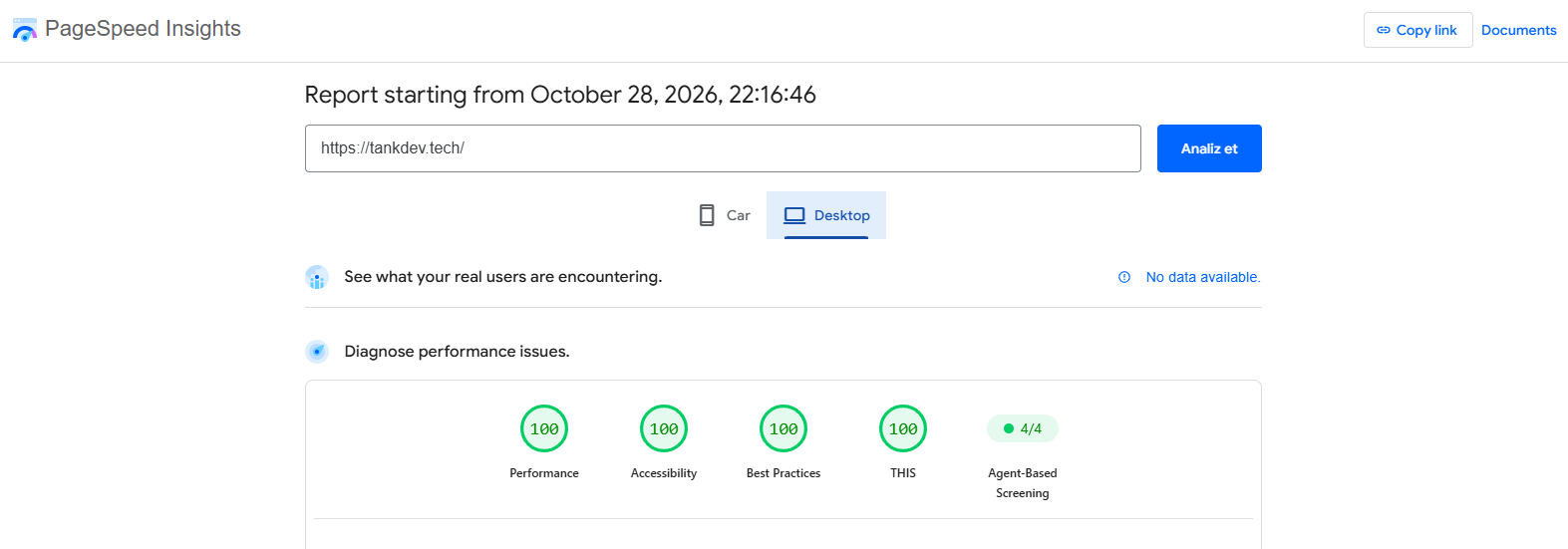
Engineering interpretationEngineering interpretation: the selected URL passed the displayed technical-quality categories under that test’s conditions. The screening result refers only to the check set represented in this report.
Measurement scopeThe image says “No data available” for real-user experience. It does not establish mobile performance, field Core Web Vitals, scores for every page, or AI recommendations.
Security report: no problems detected
“No problems were detected.”
The supplied Security issues screen shows a green check and no detected problems. This report belongs to the observation of security-related signals that may affect search visibility.

Engineering interpretationEngineering interpretation: the report documents one search-facing security observation layer. It is one input to operating and monitoring a public website.
Measurement scopeThis crop is not a penetration test or an exhaustive vulnerability assessment. It does not prove that the application has no vulnerabilities; the domain and date are not visible in the crop.
Citation observations: Citations and Cited Pages
Two separate time series
The chart shows Citations and Cited Pages on separate axes across labels from 6 September to 25 October. Both series have nonzero activity on some days in the displayed period.
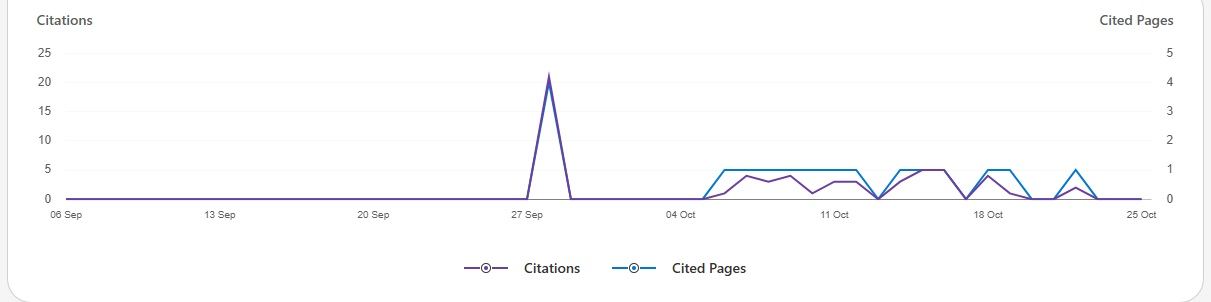
Engineering interpretationEngineering interpretation: alongside technical checks, use of content as a source is observed separately. Citation volume and the number of cited pages are different metrics.
Measurement scopeThe crop does not show the platform name, verified site filter, or period totals. We do not infer exact totals, ChatGPT-specific recommendations, revenue, or before/after growth from it.
Sitemap: successful processing and 89 discovered URLs
Success · 89 URLs
The https://tankdev.tech/sitemap.xml row shows Success, 89 discovered URLs, and a last crawl on 26 October 2026. We preserve the historical observation rather than replacing its number with today’s changing URL count.

Engineering interpretationEngineering interpretation: the page inventory was supplied to a search engine and the tool reported successful sitemap processing.
Measurement scopeDiscovering 89 URLs does not prove that all 89 were indexed, ranked, or used in AI answers. Check these outcomes separately through URL inspection and relevant performance reports.
Schema.org validation: a related WebPage and WebSite
Displayed node: 0 errors / 0 warnings
The displayed WebPage has an @id, URL, name, description, tr-TR language, and an isPartOf relationship to WebSite. The related WebSite includes Turkish and English language values; the panel shows zero errors and warnings for this displayed node.
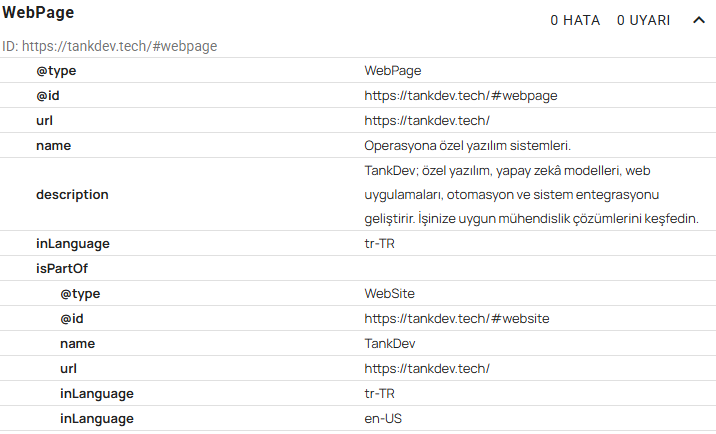
Engineering interpretationEngineering interpretation: the page is represented as a data object with explicit site and language relationships, in addition to its visible text. This is a concrete page-level output of the entity approach.
Measurement scopeThis does not verify every schema block on the website, externally corroborate every fact, or establish a knowledge panel or AI recommendation.
The outcome: inspectable SEO and GEO delivery
This evidence set shows performance, sitemap processing, structured data, and citation observations handled together on TankDev’s own website. Four scores of 100 and the 4/4 result are a lab record; 89 URLs are a sitemap observation; zero errors and warnings concern a particular schema node. Each is useful within its own scope.
GEO engineering goes beyond granting crawler access or adding markup. Keep business and page identities explicit, publish actual information accessibly, connect relevant sources through internal links, and observe answer-side use separately. Mentions, recommendations, citations, and qualified demand were not represented as one success metric.
The next measurement stage is a fixed branded/unbranded query panel, recorded platform and search mode, dated answer archives, and lead tracking through analytics and CRM. These screenshots provide initial evidence for that program, not proof of causality or commercial conversion.
Method, service scope, and external verification
Questions about this case study
Are these screens from a client project?
No. They document implementation on TankDev’s own website, not an independent customer outcome.
Do the 100 scores and 4/4 guarantee ChatGPT recommendations?
No. They are results from the displayed PageSpeed test. Measure recommendations and citations separately with recorded questions, platforms, and dates.
Does the security screen prove every vulnerability was fixed?
No. It shows no problems detected in that report. It cannot replace application security testing or a penetration test.
Can this approach be adapted to my business?
Yes, after reviewing business facts, service area, existing infrastructure, and technical requirements. Identical scores or visibility outcomes are not guaranteed.
Review your visibility infrastructure with us
Assess your website, business profiles, and actual customer questions together. Build SEO and GEO infrastructure with inspectable deliverables and explicit maintenance ownership.
Describe your engineering needs ↗