

How to Modernize Legacy Software: A Migration Plan That Protects Data and Operations
Modernize legacy software while protecting data and operations: Strangler Fig, CDC, reconciliation, write ownership, and recovery through a warehouse scenario.
· TankDev Mühendislik
Legacy software modernization makes a working system maintainable and adaptable while preserving its business rules, data, and integrations. Success is measured by orders staying intact, reservations not being duplicated, and operators knowing which record is authoritative when something goes wrong—not simply by a new interface going live.
For most businesses, the central question is: “How can we change this system while the operation continues?” The answer starts with mapping dependencies and data ownership, choosing a bounded capability, validating migrated data, and deliberately transferring write authority. Downtime and data-loss objectives then become an engineering plan; they are not unconditional promises made before discovery.
This article connects the analysis, system design, database, and integration work behind TankDev’s operational system modernization approach through a warehouse example. It is an illustrative engineering scenario, not a client case study or a claim about achieved performance. The diagrams and review templates belong to this scenario and should be adapted to your system’s boundaries.
1. Is the problem the software's age or its cost of change?
A ten-year-old application can be reliable. A two-year-old application can corrupt inventory whenever a business rule changes. A legacy system is not defined solely by old technology: poorly understood behavior, rising change costs, and fragile operations can be equally important characteristics.
Start with observable problems: lead time for a business-rule change, manual correction volume, recovery time measured in a restore rehearsal, unsupported dependencies, and failure rates for critical operations. Technical debt can explain these problems; “the code is bad” is not a sufficient investment case.
- Refactor: The capability and data model remain suitable, but internal dependencies or missing tests make changes difficult. Improve the internal structure while preserving behavior.
- Replatform: The operating system, database version, or deployment environment is the main constraint. Move the infrastructure while largely preserving functionality. A new server does not fix a wrong business rule.
- Incremental replacement: Capabilities can be separated, and the legacy system can remain safe to operate during the transition. Transfer them to the new application in stages.
- Replace with a product: Requirements are sufficiently standard, and the product meets process, export, API, and authorization needs. Include customization and exit costs alongside licensing.
- Rewrite: The system is small, its rules are verified, and an acceptable migration window exists—or continuing to operate it presents a greater risk. A rewrite still needs data migration and recovery plans.
The decision includes more than development cost. Temporary operation of two systems, data cleanup, training, licensing, support, and the risk of never retiring the old system all belong in the same assessment.
2. The scenario: replacing a dispatch capability
A distribution business enters orders into a desktop application. Overnight jobs produce inventory reports; an ERP handles invoicing, while the warehouse application owns reservations and dispatch. Some errors are corrected directly in the database. The target is a browser-based dispatch capability. Accounting and product master data will remain unchanged in the first phase.
Consider order SO-1842: the customer requests 10 units of SKU-A. The warehouse holds 20 units, 10 are reserved, and nothing has shipped. Seeing “10” on the new screen proves very little. We must preserve whether it means requested, reserved, or shipped quantity, along with its warehouse and unit of measure.
The first migration boundary is therefore creating and releasing order-line reservations and recording dispatch, rather than “the dispatch screen.” If warehouses share an inventory pool, a single-warehouse pilot is not independent. Separate the allocation boundary first, or choose a capability with fewer dependencies.
3. A discovery template before modernization
Source code does not describe the entire operation. Stored procedures, triggers, spreadsheet exports, scheduled jobs, service accounts, and reports that query tables directly are also part of the system. Interviews should be combined with real records and observations of the running application.
- Business capability: What is moving, and what remains out of scope? Who owns the decision, and who performs the daily work?
- Writer inventory: Which APIs, screens, jobs, triggers, integrations, and manual access paths can change this data?
- Data dictionary: What does each field mean? Record its unit, currency, time zone, null behavior, and authoritative source.
- Consumers: Which reports, ERP operations, and external clients depend on existing fields or status codes?
- Invariants: Which conditions must remain true before and after each operation?
- Transition agreement: Define acceptable downtime, the data-loss objective, stop conditions, the decision owner, and the recovery route.
For SO-1842, an invariant in this example with partial shipments might be: “After 4 of the 10 ordered units have shipped, no more than the remaining 6 units may have an open reservation.” Cancellation, over-delivery, and substitution policies require separate definitions. Applying a universal inventory equation without understanding existing exceptions is not data cleanup.
Characterization tests capture what the existing system actually does. When old and new results differ, the business owner determines whether the difference is a legacy defect, a new defect, or an intentional policy change. Existing behavior is evidence, not automatic proof of correctness.
4. Transitional architecture: Strangler Fig and one write authority
The Strangler Fig pattern replaces selected capabilities incrementally behind a routing layer. It does not require turning every module into a microservice; a well-structured modular monolith can also be the target. The routing layer needs its own capacity, availability, and retirement plan. Microsoft’s pattern documentation discusses the constraints of this transitional architecture.
In this scenario, routing follows warehouse and business capability. Initially, the legacy system remains the only reservation writer. The new system receives data and compares results without issuing dispatch commands or inventory movements. Once the pilot starts, the selected scope transfers write authority to the new system, and the corresponding legacy write paths are disabled.
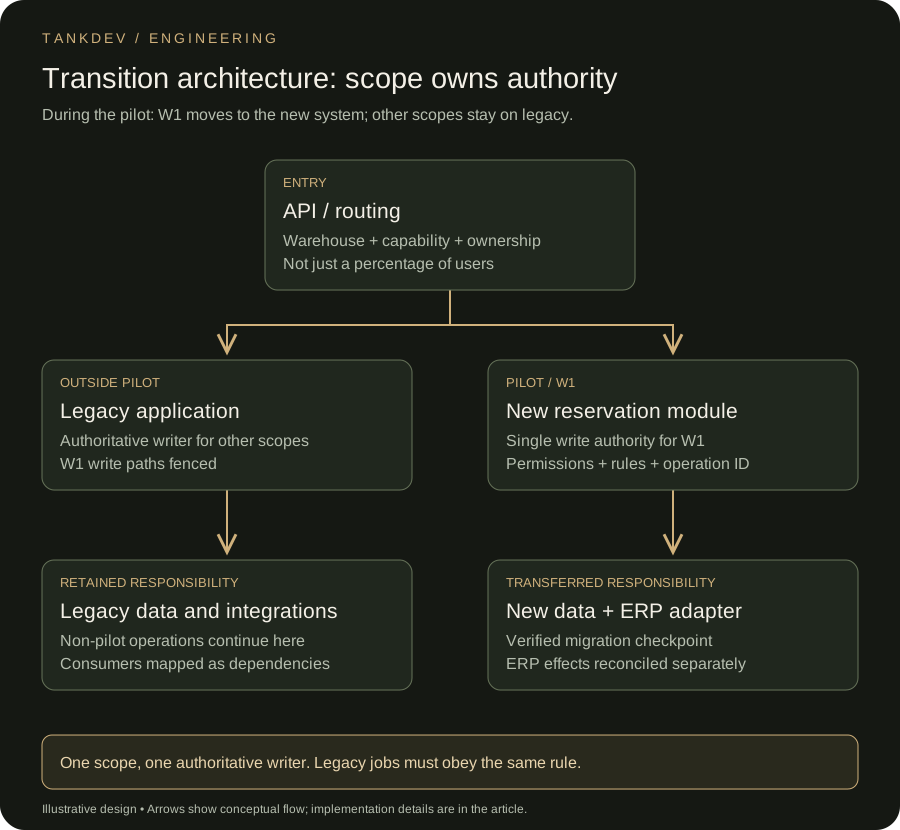
A feature flag that only redirects traffic is insufficient. If an old scheduled job can still change inventory, there are two authorities. Ownership records, transition versions, and checks that reject unauthorized writes must cover every writer, including jobs, service accounts, and direct database access. If the legacy application cannot enforce this boundary, broader access restrictions or a planned write pause are required.
Translate an old value such as status=7 through an adapter into a defined concept—for example, “partially dispatched”—instead of spreading the code throughout the new domain model. This anti-corruption layer isolates legacy semantics. An authenticated user still needs permission for the warehouse and action; the migration adapter must not become an authorization bypass.
5. Data migration: snapshots, change streams, and meaning
Begin with a source-to-target mapping. Preserve the relationship between legacy_order_id and the new identity; include the company and source system because different companies can reuse the same number. Do not merge ambiguous customer matches by guesswork. Put them into a review queue. Every transformation should be reproducible, with identifiable affected records.
A common approach for a running system is a consistent initial snapshot followed by CDC, or Change Data Capture, to apply subsequent changes. The critical detail is coordinating the snapshot with a source log position. Otherwise, a reservation created during the copy can fall into the gap between those two phases.
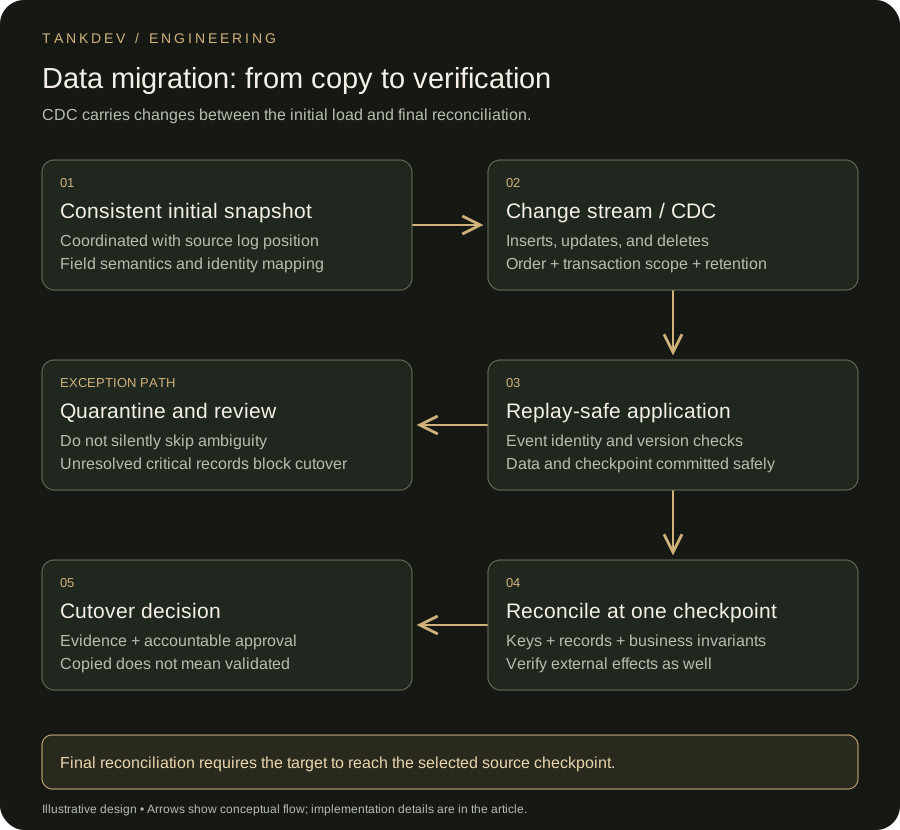
CDC does not guarantee business correctness. Updates and deletes matter as much as inserts, along with ordering, source transaction boundaries, repeat delivery, and schema changes. When one change affects several target tables, define target atomicity or how temporary inconsistency will be hidden. The progress checkpoint should be safely committed with the target changes in the same transaction, or an equivalent replay guarantee must be provided.
If SO-1842’s ten-unit reservation event arrives again, adding another ten units is wrong. Detect repeats using a source event identity or reliable log position. Prevent a late, older record version from overwriting a newer state. Record identity and event identity are different: one order can generate many valid changes.
When both source and target are PostgreSQL, native logical replication may be an option. However, DDL changes and sequence values are not automatically replicated; prepare them separately before enabling target writes. Moving from another database to PostgreSQL requires a transfer mechanism compatible with that source. See PostgreSQL’s logical replication restrictions.
Change-log retention and disk capacity also belong in the migration plan. If the consumer stops for too long, required log entries can expire or, depending on the mechanism, accumulate and put pressure on source storage. Rehearsals should cover the lag limit, the alert, and the condition that requires a fresh initial snapshot, as well as ordinary restarts.
If CDC is unavailable, a reliable change table or a controlled write pause followed by a final delta transfer may be appropriate. Polling only updated_at can miss deletes, backdated corrections, or records sharing a timestamp. “Fetch everything since the last synchronization” is not a safe assumption without an explicit source change contract.
6. Schema and API evolution: expand, migrate, contract
Adding the field required by a new release and deleting the old one in the same deployment can break older workers and reports. Expand–migrate–contract first introduces a compatible extension, then migrates data and consumers, and finally removes the unused contract. Parallel Change explains this separation.
Suppose quantity means “requested” in one place and “reserved” elsewhere. Renaming it is insufficient. Introduce requested_quantity and reserved_quantity, populate each from its verified source, and track the conversion of reports that read the old field. Keep the old representation and conversion code until the recovery window has closed.
Adding an API field does not prove every consumer will continue working. Test strict schema validators, enum values, and error responses against consumer contracts. Preserve operation identities for inventory-changing requests; retrying a request against a new endpoint must not create a second dispatch. The API and system integration guide develops these integration concerns in more detail.
7. Reconciliation: do equal row counts prove correctness?
No. Having 100,000 rows in both databases does not prove they represent the same 100,000 business events. Assigning SO-1842 to the wrong warehouse leaves the row count unchanged. One missing reservation and one excess reservation can also produce a deceptively correct total.
Compare at a common logical checkpoint: committed source operations through a chosen log position against target operations applied through that same position. Comparing an actively changing source with a lagging target produces false discrepancies. Completion of the initial load is distinct from completion of validation; AWS DMS validation documentation likewise tracks migrated and validated records separately.
- Structural checks: Unique keys, required fields, referential integrity, and identity-mapping coverage.
- Record checks: Compare business fields using explicit normalization rules for dates, nulls, decimal precision, and ordering.
- Business checks: Open reservations by warehouse and SKU, shipped quantities by order, and document references.
- Exception checks: Count quarantined, uncomparable, and deliberately transformed records separately, with an owner and explanation for each.
- Side-effect checks: Verify that movements sent to the ERP actually exist there and have not been duplicated.
In our example, after a four-unit shipment, the aligned checkpoint should show physical stock of 16, an open reservation of 6, and shipped quantity of 4. Available stock remains 10. This is an illustrative calculation assuming no negative inventory or other concurrent movements. Production reconciliation must implement your actual stock policy.
8. Shadow operation and pilots do not mean executing twice
During a shadow run, the new application calculates decisions from real inputs but has no authority to act externally. It does not print shipping labels, send email, or post ERP movements. Side-effecting clients use test adapters or are technically prevented from acting. Asking operators not to press a button is not an isolation mechanism.
Comparison must go beyond the happy path: partial dispatch, cancellation, duplicate submission, expired reservations, ERP timeouts, unauthorized warehouse access, and CDC consumer restarts. Normalize timestamps and random identifiers where appropriate without hiding business-significant differences.
An example pilot boundary is a warehouse with an independent inventory pool. The new system becomes authoritative for that scope while other warehouses remain on legacy. If transferring an order between warehouses crosses the pilot boundary, explicitly prevent that flow or design it separately. Randomly routing five percent of users is not, by itself, a safe canary strategy for shared stock.
9. A practical go-live decision template
Cutover is a transfer of write authority, not just a deployment. The following JSON is a completed decision record for the illustrative pilot. It is neither executable configuration nor a set of universal thresholds. Agree the measures with the operations owner and verify them in a migration rehearsal.
{
  "scope": "warehouse-W1-reservations-and-dispatch",
  "source_of_truth_before": "legacy",
  "source_of_truth_after": "new-system",
  "write_pause_budget_minutes": 15,
  "data_loss_target": "zero-acknowledged-business-operations",
  "required_checks": {
    "legacy_writers_fenced": true,
    "in_flight_commands_resolved": true,
    "target_applied_through_cutover_checkpoint": true,
    "critical_reconciliation_mismatches": 0,
    "unresolved_in_scope_quarantine_records": 0,
    "restore_rehearsal_passed": true
  },
  "decision_owner_role": "operations-lead",
  "after_new_writes": "freeze-and-reconcile-before-any-failback"
}
First stop accepting new commands for the pilot scope and communicate the maintenance state. Resolve in-flight commands and operations with uncertain ERP outcomes. Fence legacy writers, record the final source position, and confirm that the target has applied through it. Enable the new write authority only after final reconciliation and permission checks pass. If the time budget is exceeded, the decision owner stops the transition rather than skipping checks.
Here, the zero-data-loss objective means preserving business operations acknowledged as accepted to the user. An unsent draft prepared only in the browser is outside that agreement. RPO describes an acceptable data-loss window; RTO describes acceptable recovery time. Neither is the same measure as the migration’s write-pause budget. Possession of a backup file proves none of these objectives: restore and reconciliation rehearsals are required.
10. The recovery boundary: has the new system accepted writes?
If the new system has made no business writes and legacy data remains unchanged, restoring the legacy writer is relatively straightforward. Once the new system records a four-unit dispatch for SO-1842, the old system is behind. Redirecting traffic back does not reverse that shipment or its ERP effects.
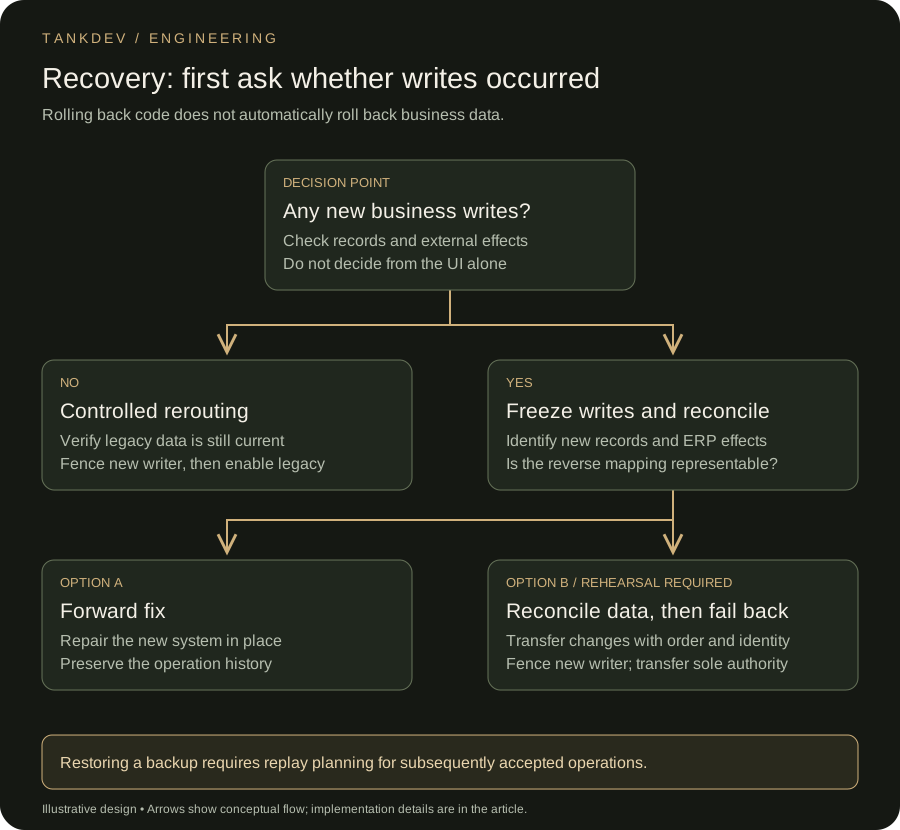
There are two practical routes: fix the new system in place, or pause writes and transfer the new records back into a representation the legacy model can support. The second requires rehearsed reverse transformations, event ordering, operation identities, and reconciliation with external systems. If the new model contains a state the old model cannot represent, the automatic failback boundary has been crossed.
Replaying the technical record of a shipment already posted to the ERP must not cause another physical shipment. Where a correction is necessary, use the cancellation or compensation operation supported by the business process. Restoring the latest backup also requires a replay plan for every accepted operation after that backup. Code rollback, data rollback, and compensation for business effects are three separate decisions.
11. Observe production and actually retire the old system
On the first day, CPU and HTTP error rates are insufficient. Monitor CDC lag, the age of the oldest pending integration job, unresolved reconciliation differences, rejected legacy-writer attempts, and incomplete dispatches by pilot scope. Can the required month-end reports still be produced? Can an operator resolve an error without editing SQL tables directly?
Technical and operational signals should be traceable through the same record identity. Audit logs capture the transformation version, migration job, manual exception decision, and ownership transfer. Do not copy personal or sensitive records wholesale into application logs; restrict migration files and service accounts to the access they need.
Define retirement criteria at the beginning: dependent consumers have moved, required reporting periods have been validated, archive retrieval has been tested, retention requirements are met, and the recovery window has formally closed. Then remove legacy jobs and access keys, and dispose of unnecessary copies according to retention policy. Keeping both systems indefinitely can multiply the debt you intended to remove.
Frequently asked questions
Is rewriting legacy software always better?
No. Rewriting a large system with poorly understood behavior risks losing undocumented rules. A complete replacement can be reasonable for a small, well-bounded system. Decide using separability, verified rules, data volume, the risk of continued legacy operation, and the organization’s migration capacity.
Is zero-downtime data migration really possible?
It is possible in some architectures, but cannot be guaranteed for every system. It requires mechanisms such as CDC, verified replay behavior, and safe write-authority transfer. For many operations, a short planned write pause may be more manageable than complex bidirectional synchronization. Continuous access and continuous write availability are different requirements.
Does modernization require microservices or AI?
No. A modular application and relational database may be sufficient. AI can assist with activities such as code inventory or document classification, but it is not the mechanism that guarantees inventory accuracy or data reconciliation. Deterministic checks and accountable human approval govern migration acceptance.
How are cost and duration estimated?
Before counting screens, assess dependencies, data quality, integration contracts, uncertain business rules, and rehearsal requirements. Discovery should produce scope, assumptions, stages, risks, and acceptance criteria rather than a single optimistic date. An illustrative article cannot provide a reliable price or schedule for a specific migration.
Modernization delivers more than new code
For TankDev, the engineering deliverables of software modernization include the dependency map, data-mapping contract, automated validation, API compatibility, transition plan, and an operable recovery route alongside the target architecture. The new system must work, and its data authority and failure behavior must be explicit.
If you are digitizing a process for the first time, the business-process-to-software guide provides the starting point. For target-system design, see enterprise software architecture. When replacing a running system, the decisive question is whether responsibility can be transferred while preserving the correctness of the operation.
Frequently asked questions
01When should legacy software be modernized?
Not merely because the technology is old. Consider modernization when security updates are no longer viable, data quality is degrading, integrations cannot be built, or business change is slow and risky. Measure business impact and dependencies before deciding which boundary actually needs change.
02What is the largest risk in a data migration project?
Treating migration as table copying. If field meanings, duplicates, history, identity mapping, and business rules are not verified, the new system can reproduce old errors faster. Write the source-to-target mapping and reconciliation criteria before migration.
03Is a big-bang or phased migration safer?
Neither is universally safer. A one-time cutover can work when dependencies are limited and rollback is tested. Where interruption risk is high, phased migration with parallel validation and explicit cutover criteria offers more control. Choose according to continuity needs.
04Must every legacy record move to the new system?
No. Move data needed for current operations, legal retention, and reporting; lower-value history can remain in an accessible read-only archive. Decide based on user needs, retention duties, data quality, and migration cost.
05How is data correctness proven after migration?
Record counts alone are insufficient. Reconcile key totals, samples, relationship counts, state distributions, and business outcomes with the source. Business users should run critical scenarios, and each discrepancy needs an owner and resolution date.
06How can operations continue during modernization?
Define the cutover window, data-freeze rule, rollback plan, support owners, and communications in advance. Start with a limited user group where appropriate. If dual entry is unavoidable, set an end date and record owner; permanent parallel systems create ambiguity.